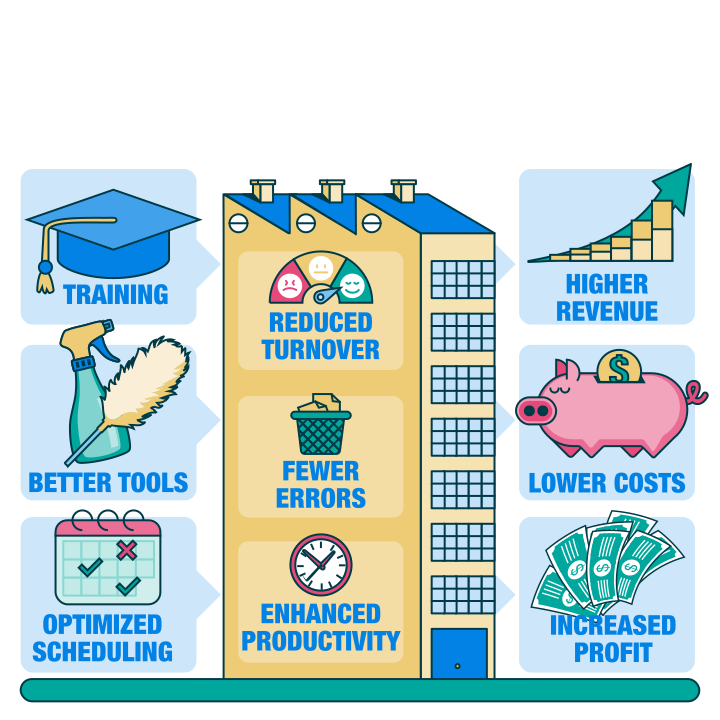
Revenue ceiling — it’s the invisible barrier that stops most residential cleaning businesses between $200K and $400K in annual revenue. You’re working harder than ever, but growth has stalled. This comprehensive guide reveals why 70% of cleaning businesses hit this revenue ceiling and the exact systems you need to break through to $1M+.
Why the Revenue Ceiling Exists at $200K–$400K
The $200K–$400K revenue ceiling isn’t random. It’s the exact point where owner-operated systems break down and business-operated systems must take over. According to SCORE’s 2023 research, over 70% of small business owners report an inability to delegate effectively, trapping them in operational roles.
At this revenue level, you’re facing three critical bottlenecks:
- Owner Dependency — Every decision, every problem, every customer issue flows through you
- Lack of Systems — What worked at $100K creates chaos at $300K
- Team Instability — Turnover spikes to 30%+ during growth plateaus, destroying profitability
📊 Industry Reality
Research shows that 73% of mid-market companies ($10M–$25M) experience stagnation, and 55% of founder-led businesses between $10M–$12M see growth decelerate. The revenue ceiling pattern starts early — at your current stage.
The Hidden Costs of the Revenue Ceiling
The revenue ceiling doesn’t just limit growth — it creates a cascade of hidden costs that erode profitability. According to research from the U.S. Small Business Administration, businesses stuck in growth plateaus experience 20–40% operational inefficiency compared to their optimized state.
These inefficiencies manifest as:
- Owner Burnout — Working 60–70 hours per week with no end in sight
- Quality Inconsistency — Without systems, service quality varies by technician and day
- Cash Flow Volatility — Unpredictable revenue makes planning impossible
- Competitive Disadvantage — Competitors with better systems win on price and service
The longer you stay stuck at the revenue ceiling, the harder it becomes to break through. Habits solidify, team members resist change, and the gap between where you are and where you need to be widens.

The 5 Systems That Break Through the Revenue Ceiling
Breaking through the revenue ceiling requires implementing five foundational systems. These aren’t nice-to-haves — they’re the difference between staying stuck at $300K and scaling to $1M+.
System 1: Strategic KPI Framework
You can’t manage what you don’t measure. The 12 Core KPIs framework provides real-time visibility into your business performance:
- Direct Payroll to Revenue Ratio — Target 40% or lower for sustainable profitability
- Jobs Per Week Per Technician — 8–9 jobs signals it’s time to hire
- System-to-Admin Ratio — Best performers achieve 2,000:1 or higher
- Customer Retention Rate — 90%+ retention is the foundation of predictable growth
Without automated KPI tracking, you’re flying blind. Manual spreadsheets can’t keep pace with the complexity of a $300K+ operation.
System 2: Structured Payroll Management
Payroll chaos kills growth. When Direct Payroll to Revenue exceeds 45%, profitability evaporates. The solution is core-plus-flex staffing:
- Core Team — Maintain 6–8 full-time technicians for baseline capacity
- Flex Capacity — Add part-time or on-call staff for demand spikes
- Automated Scheduling — Use intelligent scheduling to optimize routes and minimize drive time
- Real-Time Tracking — Monitor payroll percentage daily, not monthly
💡 Pro Tip
Every 1% reduction in Direct Payroll to Revenue adds $3,000–$4,000 to annual profit at $300K revenue. At $500K, that’s $5,000–$6,500 per percentage point.
System 3: Team Development & Retention
Turnover spikes to 30%+ during growth plateaus, costing you $3,000–$5,000 per replacement. Breaking through the revenue ceiling requires building a stable, self-managing team:
- Standardized Training — Document every process so new hires can onboard in 2 weeks, not 2 months
- Performance Scorecards — Give technicians real-time feedback on quality and customer satisfaction
- Career Pathways — Create team lead and supervisor roles to retain top performers
- Transparent Communication — Use two-way text messaging to keep everyone aligned
According to research on employee turnover in cleaning businesses, companies with structured retention programs maintain 85%+ retention rates versus 60–70% industry average.

System 4: Operational Efficiency & Automation
Manual processes that worked at $150K create bottlenecks at $300K. System-to-admin ratios reveal operational efficiency:
| Performance Level | System-to-Admin Ratio | What It Means |
|---|---|---|
| Best-in-Class | 2,000:1 or higher | Highly automated, scalable operations |
| Good | 1,000:1 to 2,000:1 | Some automation, room for improvement |
| Average | 500:1 to 1,000:1 | Manual processes limiting growth |
| Poor | Below 500:1 | Owner bottleneck, unsustainable |
To improve your ratio, implement:
- Automated Scheduling — Eliminate manual calendar management
- Customer Self-Service — Enable online booking and rescheduling
- Integrated Billing — Automate invoicing and payment processing
- Workflow Automation — Set up triggers for follow-ups, reminders, and quality checks
System 5: Data-Driven Growth Forecasting
Breaking through the revenue ceiling requires knowing when to hire, when to invest in marketing, and when to expand capacity. Growth forecasting transforms reactive management into proactive strategy:
- Lead Volume Tracking — Monitor lead flow weekly to predict revenue 30–60 days out
- Capacity Planning — Know exactly when you’ll hit 90% capacity and need to hire
- Seasonal Adjustments — Plan for Q4 surge and Q1 slowdown
- Investment Timing — Make data-driven decisions on equipment, vehicles, and staff
📈 Growth Insight
Companies using data-driven forecasting grow 2.5x faster than those relying on gut instinct. The Professional Cleaning Index Report shows MaidCentral users consistently outperform industry averages in revenue growth and profitability.
Common Mistakes That Keep You Stuck
Many cleaning business owners make the same mistakes when trying to break through the revenue ceiling:
- Hiring Too Late — Waiting until you’re overwhelmed instead of using data to predict hiring needs
- Investing in Marketing Without Capacity — Generating leads you can’t service damages your reputation
- Copying Competitors — What works for a $100K business won’t work at $300K
- Avoiding Technology — Manual processes that “work fine” are actually costing you $20K–$40K annually
- Neglecting Team Development — High turnover destroys profitability and customer satisfaction
According to Harvard Business Review research, the most successful scaling businesses balance consistency (systems and processes) with agility (adapting to market changes). The revenue ceiling exists where consistency breaks down.
How MaidCentral Breaks the Revenue Ceiling
MaidCentral was built specifically to help residential cleaning businesses break through the $200K–$400K revenue ceiling. Unlike generic software, every feature addresses the exact bottlenecks that trap growing businesses:
- Automated KPI Tracking — The 12 Core KPIs update in real-time, no manual data entry
- Payroll Optimization — Track Direct Payroll to Revenue daily and get alerts when you exceed targets
- Intelligent Scheduling — Optimize routes, minimize drive time, and maximize jobs per day
- Team Performance Tools — Scorecards, training modules, and communication tools reduce turnover
- Growth Forecasting Dashboard — Predict revenue, capacity, and hiring needs 60–90 days out
According to the Professional Cleaning Index Report, MaidCentral users maintain an average Direct Payroll to Revenue ratio of 38–42% versus 45–50% industry average — a difference of $15,000–$30,000 in annual profit at $300K revenue.

The Path from $400K to $1M+
Breaking through the revenue ceiling isn’t about working harder — it’s about implementing systems that work without you. Here’s your roadmap:
- Audit Your Current State — Calculate your Direct Payroll to Revenue, system-to-admin ratio, and retention rate
- Implement KPI Tracking — Start with the 12 Core KPIs to gain visibility
- Optimize Payroll — Move to core-plus-flex staffing and target 40% or lower
- Automate Operations — Eliminate manual scheduling, billing, and follow-ups
- Build Your Team — Create training programs, career pathways, and retention systems
- Scale with Data — Use forecasting to time hiring, marketing, and capacity investments
The businesses that break through to $1M+ don’t have better technicians or more customers — they have better systems. They’ve moved from owner-operated chaos to business-operated clarity.
🚀 Ready to Break Through Your Revenue Ceiling?
See how MaidCentral helps residential cleaning businesses scale from $200K–$400K to $1M+ with automated systems, real-time KPIs, and data-driven growth tools.
Frequently Asked Questions
What is a revenue ceiling and why does it happen at $200K–$400K?
A revenue ceiling is the point where business growth stalls despite continued effort. The $200K–$400K range is where owner-operated systems break down and business-operated systems must take over. Without this transition, owners become the bottleneck, working 60+ hours per week with no path to scale.
How do I calculate my Direct Payroll to Revenue ratio?
Divide your total direct labor costs (technician wages, payroll taxes, workers comp) by your total revenue, then multiply by 100. For example: $12,000 in payroll ÷ $30,000 in revenue = 0.40 or 40%. Target 40% or lower for sustainable profitability.
What is a system-to-admin ratio and why does it matter?
System-to-admin ratio measures how many automated processes you have per administrative task. Best-in-class cleaning businesses achieve 2,000:1 or higher, meaning technology handles most routine work. Poor ratios (below 500:1) indicate the owner is trapped in manual operations.
How can MaidCentral help me break through my revenue ceiling?
MaidCentral provides the five systems needed to break through: automated KPI tracking, payroll optimization, intelligent scheduling, team performance tools, and growth forecasting. These systems eliminate the owner bottleneck and enable scaling to $1M+.
How long does it take to break through the revenue ceiling?
Most cleaning businesses see measurable progress within 90–120 days of implementing proper systems. However, sustainable growth to $1M+ typically takes 18–24 months of consistent execution with the right tools and processes in place.
Related Resources
- Master Growth Forecasting for Your Cleaning Business
- Complete Guide to Payroll to Revenue Optimization
- How to Reduce Employee Turnover in Cleaning Businesses
- Learn About Intelligent Scheduling
- Download the Professional Cleaning Index Report
About MaidCentral: Built by cleaning professionals for cleaning professionals. We help residential cleaning businesses break through growth barriers with data-driven systems and automation. Learn more.