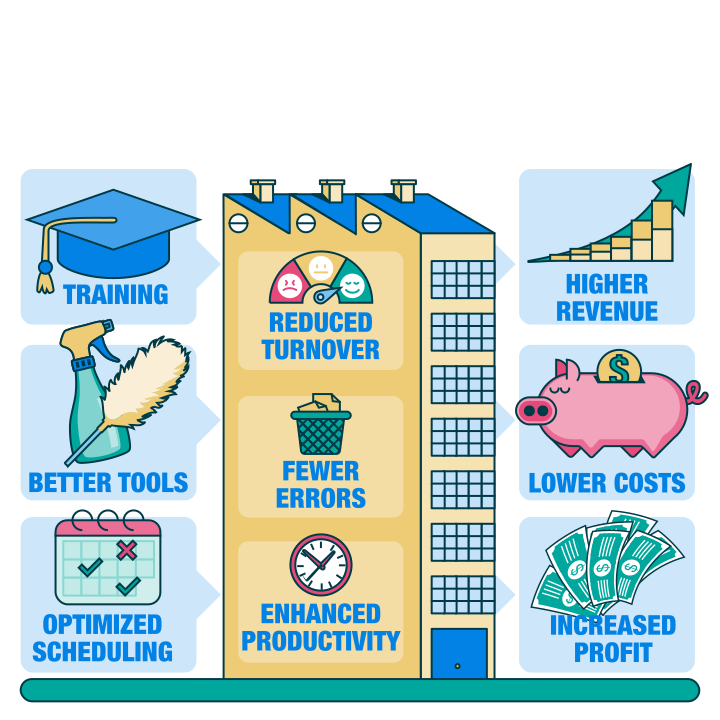
Sales-driven vs profit-driven cleaning business models represent two fundamentally different approaches to growth. One chases revenue at any cost. The other builds sustainable wealth. This comparison reveals which path leads to long-term success.
Understanding Sales-Driven vs Profit-Driven Cleaning Business Models
The distinction between sales-driven and profit-driven business models determines whether you build a company that generates cash or one that burns through it.
A sales-driven cleaning business prioritizes revenue growth above all else. Owners focus on booking more jobs, expanding service areas, and increasing gross revenue numbers. The assumption is that higher sales automatically translate to business success.
A profit-driven cleaning business prioritizes net profitability and operational efficiency. Owners focus on margin optimization, cost control, and sustainable growth. The goal is building a business that generates wealth, not just revenue.
Key Insight
Research shows that asset-light service businesses achieve 20-30% return on invested capital when profit-focused, compared to just 8-12% for asset-heavy models that prioritize sales volume over margins.
The Sales-Driven Approach: Chasing Revenue
Sales-driven cleaning businesses operate under a simple philosophy: more revenue solves all problems. This approach has specific characteristics:
- Revenue targets dominate decision-making – Growth measured solely by gross sales
- Aggressive pricing to win jobs – Undercutting competitors to increase market share
- Rapid expansion without infrastructure – Adding service areas before systems are ready
- High customer acquisition costs – Spending heavily on marketing without retention focus
- Thin or negative margins – Accepting unprofitable work to hit revenue goals
The Revenue Ceiling Problem
Sales-driven businesses typically hit a revenue ceiling between $200,000 and $400,000 annually. At this point, the owner works 60-80 hours per week but takes home less than they could earn as an employee elsewhere.
The problem is structural. Without margin discipline, increased revenue requires proportionally increased expenses. Labor costs spiral. Equipment needs multiply. Administrative overhead grows. The business becomes a hamster wheel that runs faster but goes nowhere.
Common Sales-Driven Mistakes
Owners pursuing sales-driven growth make predictable errors:
- Accepting unprofitable jobs – Taking work at rates below true cost to maintain revenue momentum
- Neglecting labor cost management – Allowing payroll to exceed 40% of revenue without adjustment
- Overinvesting in acquisition – Spending on new customers while existing customers churn
- Ignoring operational efficiency – Failing to optimize routes, scheduling, and resource allocation
- Scaling before systems – Growing headcount without processes to support it
The Profit-Driven Approach: Building Wealth
Profit-driven cleaning businesses operate under a different philosophy: sustainable profitability creates freedom and wealth. This approach focuses on fundamentals:
- Margin optimization drives decisions – Every choice evaluated for impact on net profit
- Value-based pricing – Rates set to ensure healthy margins, not match competitors
- Controlled growth with infrastructure – Expansion only when systems support it
- Customer lifetime value focus – Retention prioritized over acquisition
- Operational efficiency – Continuous improvement of processes and productivity
The Profit-First Framework
Profit-driven businesses follow a disciplined framework for financial management. The typical structure targets these benchmarks:
| Metric | Target Range | Purpose |
|---|---|---|
| Direct Labor Cost | 35-40% of revenue | Sustainable wage structure |
| Operating Expenses | 25-30% of revenue | Overhead control |
| Net Profit Margin | 20-30% of revenue | Owner compensation + reinvestment |
| Customer Retention | 90%+ annually | Predictable revenue base |
These targets create a business that generates wealth. A $500,000 revenue business operating at 25% net margin produces $125,000 in owner profit annually. The same revenue at 10% margin produces just $50,000.
Real-World Profit-Driven Results
The data from actual cleaning businesses demonstrates the profit-driven advantage. According to industry research, residential cleaning businesses typically achieve net margins between 10% and 28%, with top operators reaching 20-30% or higher.
One documented case study from a MaidCentral user shows the transformation possible with profit-focused management. NaturalCare Cleaning achieved:
- Revenue increase of 37%
- Hourly rate increase of 25%
- Labor cost reduction from 50% to 40% of revenue
- Net profit increase of over $100,000 annually
The key was shifting focus from revenue growth to margin optimization and operational efficiency.
Sales-Driven vs Profit-Driven Cleaning Business: Direct Comparison
The differences between these approaches become clear when compared side by side:
Decision-Making Framework
Sales-driven: “Will this increase revenue?” drives every choice. Owners accept low-margin work, discount aggressively, and expand without infrastructure because it boosts gross sales numbers.
Profit-driven: “Will this improve net profitability?” drives every choice. Owners decline unprofitable work, maintain pricing discipline, and grow only when systems support it.
Pricing Strategy
Sales-driven: Competitive pricing or undercutting to win market share. Rates set based on what competitors charge, often resulting in margins too thin to sustain operations.
Profit-driven: Value-based pricing that ensures healthy margins. Rates set based on true costs plus target profit, typically $150-$250 per standard residential clean.
Growth Approach
Sales-driven: Rapid expansion into new markets and service areas. Adding capacity before demand is proven or systems are ready to support it.
Profit-driven: Controlled growth with infrastructure. Expanding only when current operations are optimized and systems can scale efficiently.
Customer Strategy
Sales-driven: Heavy investment in acquisition. Marketing budgets focused on generating new leads, often neglecting retention of existing customers.
Profit-driven: Retention-first approach. Acquiring new customers costs 5-7x more than retaining existing ones, so profit-driven businesses prioritize customer lifetime value.
Labor Management
Sales-driven: Hiring to meet demand without cost discipline. Labor costs often exceed 45-50% of revenue, crushing profitability.
Profit-driven: Strategic labor management targeting 35-40% of revenue. Optimizing scheduling, routing, and productivity to maintain healthy margins.
Why Profit-Driven Wins Long-Term
The profit-driven approach creates sustainable competitive advantages that sales-driven businesses cannot match:
Financial Resilience
Profit-driven businesses build cash reserves that provide stability during economic downturns, seasonal fluctuations, or unexpected challenges. Sales-driven businesses operate on thin margins with no buffer.
Faster Break-Even and Growth
Research indicates that profit-focused service businesses break even 2-3 times faster than revenue-focused competitors. The reason is simple: every dollar earned contributes meaningfully to the bottom line rather than being consumed by inefficient operations.
This faster path to profitability enables reinvestment in systems, technology, and team development that compound competitive advantages over time.
Owner Freedom and Quality of Life
Profit-driven businesses create owner freedom. With healthy margins and efficient operations, owners can step back from daily operations without the business collapsing. Sales-driven businesses trap owners in operational roles because margins are too thin to hire competent management.
Sustainable Competitive Position
The global cleaning services market reached $442.1 billion in 2025 and continues growing at 7.3% annually. In this expanding market, profit-driven businesses capture disproportionate value because they can:
- Invest in technology and automation that improve efficiency
- Attract and retain top talent with competitive compensation
- Deliver consistent quality that builds reputation and referrals
- Weather competitive pressure without destructive price wars

How MaidCentral Supports Profit-Driven Growth
MaidCentral was built specifically to help cleaning businesses operate profitably. The platform provides the tools and data needed to implement profit-driven management:
- Real-time financial dashboards – Track labor costs, margins, and profitability by job, customer, and time period
- Intelligent scheduling optimization – Maximize technician productivity and minimize drive time to improve margins
- Automated customer retention – Proactive communication and service quality tracking to maintain 90%+ retention
- Performance analytics – Identify profitable customers, services, and markets to focus growth efforts
The Professional Cleaning Index Report demonstrates that MaidCentral users consistently outperform industry averages in profitability and operational efficiency.
The Profit Bootcamp Advantage
For owners ready to transition from sales-driven to profit-driven operations, the MaidCentral Profit Bootcamp provides a structured 12-week program covering:
- Financial management and margin optimization
- Pricing strategy and value-based selling
- Operational efficiency and productivity improvement
- Customer retention and lifetime value maximization
- Team development and labor cost management
Ready to Build a Profitable Cleaning Business?
See how MaidCentral helps cleaning business owners shift from revenue-chasing to profit-building with data-driven tools and proven frameworks.
Frequently Asked Questions
What is the difference between sales-driven vs profit-driven cleaning business models?
A sales-driven cleaning business prioritizes revenue growth above all else, often accepting low-margin work to increase gross sales. A profit-driven cleaning business prioritizes net profitability and operational efficiency, focusing on sustainable margins and controlled growth. The profit-driven approach typically achieves 20-30% net margins compared to 10% or less for sales-driven businesses.
How do I calculate if my cleaning business is profitable?
Calculate net profit margin by subtracting all expenses (labor, supplies, overhead, marketing) from total revenue, then dividing by total revenue. Target 20-30% net margin for a healthy profit-driven business. Track labor costs specifically—they should stay at 35-40% of revenue. Use financial tracking tools to monitor these metrics in real-time.
What are typical profit margins for residential cleaning businesses?
Typical residential cleaning businesses achieve net profit margins between 10% and 28%. Top-performing profit-driven operators reach 20-30% or higher. The key is maintaining labor costs at 35-40% of revenue and operating expenses at 25-30%, leaving 20-30% for net profit and owner compensation.
How can I transition from sales-driven to profit-driven operations?
Start by implementing value-based pricing that ensures healthy margins. Track and optimize labor costs to stay at 35-40% of revenue. Focus on customer retention over acquisition. Use data to identify and eliminate unprofitable services or customers. Consider structured training like the MaidCentral Profit Bootcamp to guide the transition.
Why do sales-driven cleaning businesses hit a revenue ceiling?
Sales-driven businesses hit revenue ceilings (typically $200K-$400K annually) because thin margins require the owner to work in operations rather than on strategy. Without margin discipline, increased revenue requires proportionally increased expenses, creating a hamster wheel effect. Profit-driven businesses break through this ceiling by building systems and margins that enable delegation and scaling.
Related Resources
- Explore MaidCentral’s Profit-Optimization Platform
- Download Professional Cleaning Index Report
- Browse More Expert Business Tips
About MaidCentral: Built by cleaning professionals for cleaning professionals. Learn more.