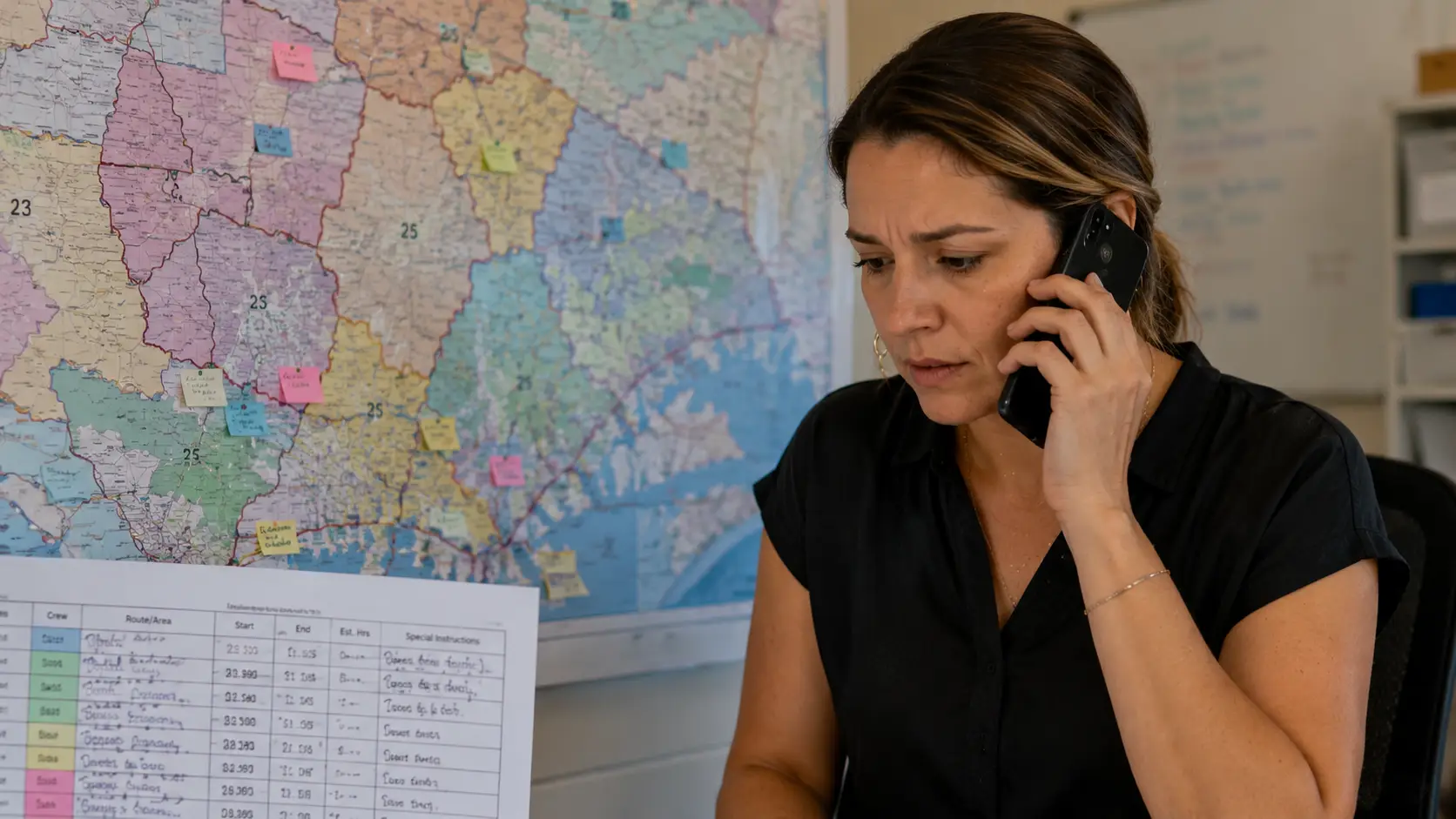
The 8am callout on the other side of the territory isn’t a scheduling problem by the time it reaches your ops manager — it’s already a cross-territory problem. She spends the next ninety minutes on the phone: checking who’s free, finding out the closest available tech is on the wrong side of town, leaving voicemails for a second option. By 9:30 it’s handled. Two territories are running forty minutes behind for the rest of the morning. You hear about it at lunch, secondhand, as a line in a status update — not because anyone hid it, but because by the time it reached you, it was already resolved and there was nothing left to do about it. Read on to find out what’s actually driving the ops manager scheduling bottleneck — and where the fix actually lives.
Here’s the number underneath that scene: technician turnover across MaidCentral’s customer base runs around 131% a year — and turnover isn’t an average worth flattening into one figure, it’s a spread. Two crews at wildly different turnover rates can post the same company-wide number if nobody’s tracking it by territory. Run your own number on how that spread breaks down crew by crew, not just company-wide — if one territory runs hotter than the rest, a single average will hide it every time.
The failure modes, structurally
None of this is about anyone’s individual competence — your ops manager solved the problem in ninety minutes, which is exactly what a capable person does when the tools hand her a phone and a spreadsheet instead of a view.
Visibility without cross-territory authority. She can see her own territory’s schedule. She can’t see, at a glance, which tech in a neighboring territory is actually free right now — so “check who’s available” means calling people instead of looking at a screen.
A backup plan that exists on paper, not in real time. A written contingency list tells you who’s qualified. It doesn’t tell you who’s already on a job, who’s running late, or who called out sick an hour ago. The list is only ever as current as the last time someone updated it by hand.
Recovery without a record. The reassignment gets solved and then it disappears — there’s no standing record of how often this territory, this crew, this time slot produces a callout, so the same fire gets fought fresh every time instead of getting prevented the second or third time it repeats.
The real question isn’t reroute speed — it’s who owns the variance
Making the ninety-minute fix faster treats the symptom. The actual governing question is whether anyone in the company owns the pattern — which territories run hot, which crews are structurally understaffed for their route density, which time slots produce the most callouts — or whether it just gets re-discovered, live, every time it happens. Visibility without micromanagement means your ops manager isn’t spending her morning reconstructing information that already existed somewhere in the system; she’s spending it on the one call that actually needs her judgment.
Curious where your own territories stand on this?
See the callout pattern by territory — not just the company-wide average.
What this looked like at Bright Side Services
Michelle Krueger built Bright Side the way most operators do — referrals, effort, and judgment — and hit the ceiling that method hits. Absenteeism sat at 33%, in-home estimates still ran the sales process, and payroll was manual. Then COVID hit staffing hard enough that she considered selling.
“Before stronger systems and data, decisions were often made from gut instinct. Now I can see what is happening, train from data, and identify problems more objectively.”
— Michelle Krueger, Owner, Bright Side Services
Absenteeism dropped from 33% to 8.53%. Average bill per clean rose from $184 to $202. Read that sequence again: the visibility came first, the numbers moved after — not the other way around.
What if it breaks?
Nothing about cross-territory visibility removes your ops manager’s judgment from the process. She still makes every real call — who’s actually the right fit for a job, how to handle a genuine exception, what to tell a client who’s upset. What changes is what she has to reconstruct by hand before she can make that call. The rollout is phased, not a single cutover: that visibility first, since that’s where the daily fires start, then the backup-plan layer. Nothing about your crews, your standards, or how you quote a job changes at any phase.
The cost of not fixing this
None of this is one dramatic failure — it’s a compounding one. A company that fixes real-time cross-territory visibility this year stops losing ninety minutes to a scramble every time a callout hits. A company that doesn’t is still spending that same ninety minutes, indefinitely, on a problem that a screen — not a phone tree — could have shown from the first call. The gap between those two companies three years out isn’t a rounding error.
Where MaidCentral fits
Scheduling, timekeeping, and job-level economics live in one system built for recurring, labor-driven service work. What you’ve been reading about here as “territory” has a name in the system: MaidCentral calls it a zone — a mapped coverage area, shared across locations on a Satellite Offices setup — with role-based access, so the reassignment call happens on a screen instead of a phone tree. This doesn’t take the decision away from your ops manager. It hands her the immediate view; whether a zone is running hot over time is still a question for the leadership meeting to ask, not one the system answers for you yet.
What Monday looks like after
Monday, 8am: the callout in that zone shows up as a flag, not a phone call — the system already shows who’s free nearby, and reassignment is a decision your ops manager makes in the same view where she saw the problem. By the Monday leadership meeting, ninety minutes of firefighting isn’t eating the agenda anymore — which means there’s actually room to ask the harder question out loud: has that zone been running hot lately? That’s not a report the system hands anyone yet. It’s a question worth someone owning by hand, every month, until it is.
Questions operators at scale ask
Is our ops manager scheduling bottleneck actually a headcount problem, or a visibility one?
It depends on how your locations are set up. On a Satellite Offices setup, locations already share one job schedule and one employee pool, so an ops manager can see techs and zones across locations in a single view today. On a Branches setup, each branch runs its own separate schedule — there’s no unified cross-branch view yet, so that visibility gap is real, not just a training problem. Either way, the underlying question is the same: is the system built to show her the immediate view, or is she reconstructing it by hand every time.
We already have a scheduling tool. What’s actually different here?
Most scheduling tools show one territory’s calendar. The gap this addresses is real-time cross-zone visibility: whether a callout in one zone can see backup capacity in a neighboring one without someone picking up a phone. Worth being direct about what this doesn’t yet do: tracking which zones run hot over weeks or months isn’t a built-in report today — that’s still a question for a person to own, not the system.
What if the rollout disrupts an ops team that’s already stretched thin?
It’s phased specifically because a stretched team can’t absorb a single cutover. Zone visibility goes live first — the layer with the fastest payoff and the least process change — before anything else changes.
How did Bright Side Services actually get from gut instinct to data without losing what worked?
Michelle kept her crews, her standards, and her way of running the business — what changed was that decisions moved from instinct to a visible pattern. The transition was gradual, not a single system replacement; see the full story for the sequence.
Break one ratio out by team this week → PCI Report — variance by crew, not just the company average.
Earlier in the journey? → Office Manager Scheduling Automation — the single-office-manager version of this same problem, before it’s a multi-zone one.
Bring your org chart to a working session
See it built around your actual zones, not a feature tour.