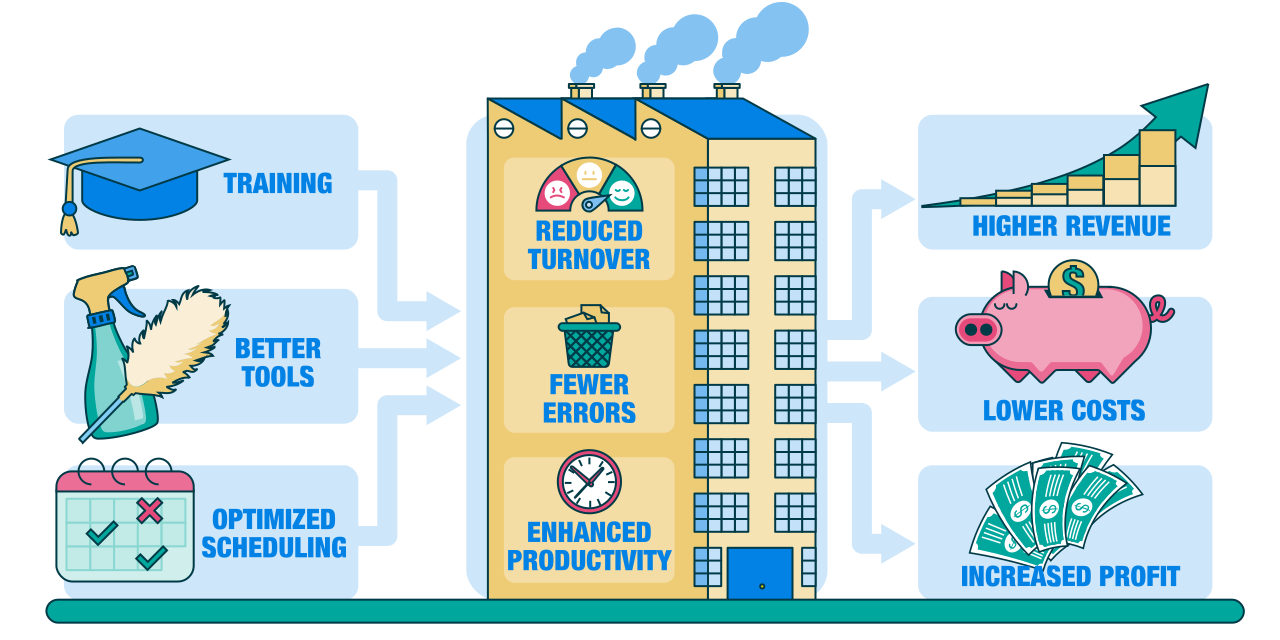
Payroll percentage is one of the most misunderstood metrics in the cleaning business. Most owners feel the pressure of high labor costs before they understand what their payroll percentage actually means—or what it’s trying to tell them about their business.
This guide reveals the healthy payroll percentage benchmarks for cleaning businesses, the warning signs that your labor costs are too high, and most importantly, what a high payroll percentage actually reveals about your operations.
What Payroll Percentage Actually Means
Your payroll percentage is the portion of your revenue that goes toward labor costs. It’s calculated as:
Payroll Percentage = (Total Labor Costs ÷ Total Revenue) × 100
But here’s what most cleaning business owners miss: there are two ways to calculate this, and the difference matters.
Direct Payroll vs. Fully Loaded Labor Costs
Direct payroll includes only wages paid to technicians. Fully loaded labor costs include wages plus payroll taxes, workers’ compensation insurance, benefits, and other labor-related expenses. According to industry research, fully loaded costs typically run 15-25% higher than direct wages[1].
For cleaning businesses, you should track both metrics:
- Direct payroll percentage – Easier to calculate, good for quick checks
- Fully loaded labor percentage – More accurate picture of true labor costs
- Total labor burden – Includes office staff and management
Why percentages matter more than raw dollars: A $50,000 monthly payroll means something very different if you’re doing $100,000 in revenue (50% payroll percentage) versus $200,000 in revenue (25% payroll percentage). The percentage tells you if your labor costs are sustainable.

The Benchmark Table: What Healthy Looks Like
Based on data from thousands of cleaning businesses and industry benchmarks, here’s what healthy payroll percentages look like at different business sizes:
| Business Size | Monthly Revenue | Healthy Payroll % | Warning Zone | Problem Zone |
|---|---|---|---|---|
| Solo/Small Team | $10K-$30K | 40-50% | 50-60% | 60%+ |
| Growing Business | $30K-$75K | 40-48% | 48-58% | 58%+ |
| Established Business | $75K-$150K | 38-45% | 45-55% | 55%+ |
| Large Operation | $150K+ | 35-42% | 42-52% | 52%+ |
These benchmarks are for direct payroll only. Add 15-25% for fully loaded costs including taxes, insurance, and benefits.
Why the Healthy Range is 40-50%
The 40-50% range for direct payroll gives you room for:
- Operating expenses – Marketing, supplies, insurance, software (20-25%)
- Owner compensation – Your salary and benefits (10-15%)
- Profit margin – Business growth and reserves (15-20%)
When payroll creeps above 50%, these other essential areas get squeezed. Above 60%, you’re likely operating at a loss or the owner isn’t taking fair compensation.
📊 Industry Benchmark
According to the Professional Cleaning Index Report, top-performing cleaning businesses maintain payroll percentages between 38-45%, while struggling businesses average 55-65%[2].
What High Payroll Percentage Actually Tells You
Here’s the critical insight most cleaning business owners miss: a high payroll percentage isn’t just a payroll problem. It’s a symptom that reveals deeper operational issues.
When your payroll percentage is consistently above 55%, it’s telling you one or more of these things:
Signal 1: Productivity Issues
Your teams are taking too long to complete jobs. This could mean:
- Technicians aren’t properly trained on efficient cleaning methods
- Teams are overstaffed for the job size
- Travel time between jobs is excessive
- Technicians lack the right tools or supplies
The fix isn’t cutting wages—it’s improving productivity through better training, proper staffing ratios, and optimized routing.
Signal 2: Pricing Problems
You’re charging too little for your services. Common pricing mistakes include:
- Quoting based on what competitors charge instead of your actual costs
- Not accounting for drive time and difficulty factors
- Failing to raise prices annually to match wage increases
- Offering too many discounts or promotions
Research shows that cleaning businesses that use data-driven pricing maintain payroll percentages 8-12 points lower than those using guesswork pricing[3].

Signal 3: Scheduling Inefficiency
Poor scheduling creates hidden labor waste:
- Technicians sitting idle between jobs
- Excessive drive time eating into productive hours
- Jobs scheduled too far apart
- Teams not optimized for job requirements
Intelligent scheduling can reduce labor waste by 15-25% without cutting wages or service quality. MaidCentral’s scheduling tools help businesses optimize routes and minimize downtime.
Signal 4: Labor Management Gaps
Without proper systems, labor costs creep up through:
- Overtime that could be avoided with better planning
- Time theft or inaccurate time tracking
- Paying for drive time that exceeds estimates
- Technicians working slower than they should
The solution isn’t micromanaging—it’s implementing systems that provide visibility and accountability.
💡 Pro Tip
Don’t just track your overall payroll percentage. Break it down by service type, team, and even individual technician. This reveals exactly where your labor efficiency issues are hiding.
How to Diagnose Your Payroll Percentage Problem
If your payroll percentage is in the warning or problem zone, follow this diagnostic process:
- Calculate Your True Payroll Percentage – Use fully loaded costs for accuracy. Include wages, taxes, workers’ comp, and benefits. Divide by total revenue for the same period.
- Break It Down by Service Type – Calculate payroll percentage separately for standard cleans, deep cleans, move-outs, etc. You’ll often find one service type is dragging down your overall numbers.
- Analyze Productivity Metrics – Track hours per job by service type. Compare to industry benchmarks. A standard 3-bedroom home should take 2-3 hours with a 2-person team.
- Review Your Pricing – Calculate your true cost per job including labor, supplies, and overhead. Add your target profit margin. Compare to what you’re actually charging.
- Examine Your Schedule – Calculate productive hours vs. paid hours. Include drive time, breaks, and downtime. Top performers achieve 75-85% productive time.
- Check Team Composition – Are you using the right team size for each job? Overstaffing by one person can increase labor costs 30-50%.
This diagnostic process reveals exactly where your payroll percentage problem originates—and what to fix first.
How MaidCentral Helps You Control Payroll Percentage
MaidCentral was built specifically to help cleaning businesses optimize labor costs without cutting wages or service quality. The platform provides:
Real-Time Payroll Percentage Visibility
Track your payroll percentage in real-time with automated reporting. See exactly how labor costs trend against revenue, broken down by service type, team, and time period. No more waiting until month-end to discover you have a problem.
Productivity Tracking and Benchmarking
Monitor hours per job and compare to benchmarks. Identify which teams or technicians are most efficient. Use data to improve training and set realistic performance standards.
Intelligent Scheduling Optimization
MaidCentral’s scheduling engine minimizes drive time and maximizes productive hours. The system suggests optimal team sizes based on job requirements and automatically routes teams for efficiency.
Data-Driven Pricing Tools
Calculate accurate quotes based on your actual labor costs, not guesswork. Factor in drive time, job difficulty, and target margins. Ensure every job is priced for profitability.
According to the Professional Cleaning Index Report, MaidCentral users maintain an average payroll percentage of 42%—significantly below the industry average of 52%.

🚀 Ready to Optimize Your Labor Costs?
See how MaidCentral helps cleaning businesses reduce payroll percentage by 8-15 points without cutting wages.
Advanced Strategies to Optimize Labor Costs
Once you understand your current metrics, implement these advanced strategies to improve efficiency without sacrificing quality:
Strategy 1: Implement Performance-Based Pay
Consider transitioning from hourly wages to performance-based compensation. This aligns technician incentives with business goals:
- Base pay plus productivity bonuses – Reward teams that complete jobs efficiently
- Quality incentives – Bonus for high customer satisfaction scores
- Retention bonuses – Reward technicians who maintain long-term client relationships
Businesses using performance-based pay report 12-18% improvement in productivity while maintaining or improving quality scores.
Strategy 2: Invest in Training and Tools
Better-trained technicians with proper equipment work faster and deliver higher quality:
- Comprehensive onboarding programs reduce time-to-proficiency by 30%
- Professional-grade equipment can cut cleaning time by 15-20%
- Ongoing skills training improves efficiency and job satisfaction
The upfront investment in training and tools typically pays for itself within 3-6 months through improved productivity.
Strategy 3: Optimize Team Composition
Match team size and skill level to job requirements:
- Use solo technicians for small apartments and maintenance cleans
- Deploy 2-person teams for standard homes
- Reserve 3+ person teams for large homes or deep cleans
- Pair experienced technicians with newer team members for training
Right-sizing teams can reduce labor costs by 10-15% while maintaining service quality and completion times.
Strategy 4: Leverage Technology for Efficiency
Modern software eliminates administrative waste and improves field productivity:
- Automated scheduling reduces planning time by 75%
- Mobile apps eliminate paperwork and improve communication
- GPS tracking optimizes routes and verifies job completion
- Real-time reporting provides instant visibility into labor costs
MaidCentral’s platform integrates all these tools to help businesses reduce administrative overhead and improve field efficiency.
Common Mistakes to Avoid
When trying to improve labor metrics, avoid these common mistakes that can backfire:
Mistake 1: Cutting Wages to Reduce Costs
Reducing wages seems like a quick fix, but it typically leads to:
- Higher turnover and constant recruiting costs
- Lower quality work and customer complaints
- Difficulty attracting skilled technicians
- Damaged reputation in your market
The real solution is improving productivity and pricing, not cutting compensation.
Mistake 2: Rushing Jobs to Improve Metrics
Pressuring teams to work faster without proper training or tools results in:
- Declining quality and customer satisfaction
- Increased customer churn
- Technician burnout and turnover
- Damage to your brand reputation
Focus on working smarter, not just faster.
Mistake 3: Ignoring the Root Cause
Many owners try to fix symptoms without addressing underlying issues:
- Adding more jobs to spread labor costs (without fixing pricing)
- Micromanaging technicians (instead of improving systems)
- Cutting corners on supplies (which slows down teams)
Use data to identify the real problem, then implement systematic solutions.
Frequently Asked Questions
What is a healthy payroll percentage for cleaning businesses?
A healthy payroll percentage for cleaning businesses ranges from 40-50% for direct payroll costs. This allows room for operating expenses (20-25%), owner compensation (10-15%), and profit (15-20%). Top performers maintain 38-45%.
How do I calculate my payroll percentage?
Calculate payroll percentage by dividing total labor costs by total revenue, then multiplying by 100. For example: $40,000 in labor ÷ $100,000 in revenue × 100 = 40% payroll percentage. Use the same time period for both numbers.
What does it mean if my payroll percentage is over 60%?
A payroll percentage over 60% indicates serious operational issues—typically a combination of pricing problems, productivity issues, and scheduling inefficiency. At this level, you’re likely operating at a loss or the owner isn’t taking fair compensation.
How can MaidCentral help reduce my payroll percentage?
MaidCentral helps reduce payroll percentage through intelligent scheduling that minimizes drive time, productivity tracking that identifies inefficiencies, and data-driven pricing tools that ensure profitable quotes. Users average 42% payroll percentage vs. 52% industry average.
Should I include payroll taxes in my payroll percentage calculation?
Yes, for the most accurate picture, include fully loaded labor costs: wages plus payroll taxes (7.65%), workers’ compensation insurance (varies by state), and any benefits. This typically adds 15-25% to direct wages and gives you a true labor cost percentage.
Related Resources
- Explore MaidCentral’s Labor Management Tools
- Download Professional Cleaning Index Report
- Learn About Intelligent Scheduling
- Schedule Free Demo
- Browse More Expert Tips
About MaidCentral: Built by cleaning professionals for cleaning professionals. Learn more.