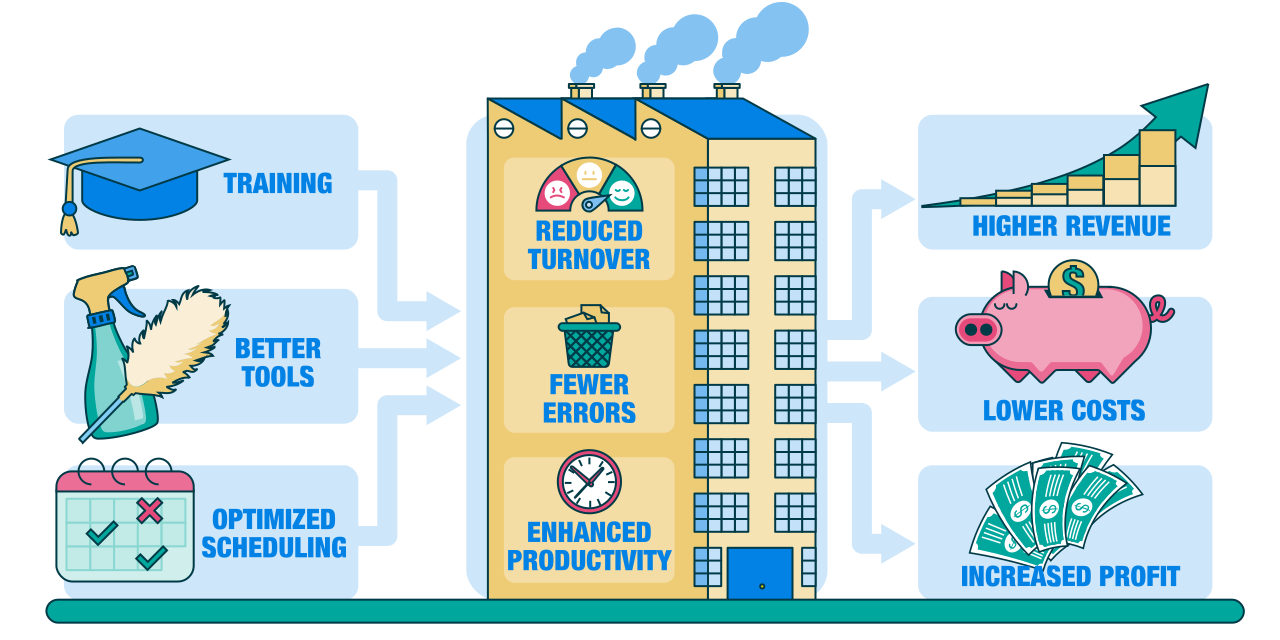
For established residential cleaning companies, revenue growth is no longer enough by itself. The real question is whether added revenue is improving margins, productivity, schedule quality, and leadership control—or just making the business heavier.
At scale, revenue alone is an incomplete and sometimes misleading optimization target. Profit is the better governing metric because it reflects the quality of operations underneath the top line. A cleaning business that optimizes only for revenue can become larger, busier, and more complex without becoming more efficient, more controllable, or more valuable.

Why Revenue Remains Seductive at Scale
Revenue is the easiest number to celebrate. It signals growth externally, creates confidence internally, and provides a simple answer to the question: “How’s business?”
But for residential cleaning businesses operating at scale, revenue growth can hide deterioration in the fundamentals:
- Labor efficiency declines as teams expand without productivity discipline
- Pricing discipline weakens when volume becomes the primary goal
- Operating quality suffers as complexity outpaces management systems
- Schedule density deteriorates when growth happens without route optimization
According to industry research, the residential cleaning services market is projected to grow 6.2% annually through 2030. But growth alone does not guarantee profitability. Many cleaning businesses scale revenue while watching margins compress and operational control slip away.
Why Profit Is the Better Optimization Target
Profit captures whether the business is converting scale into real value. It requires leadership to look beyond the top line and examine the quality of operations:
Direct Payroll to Revenue
This ratio reveals labor efficiency. MaidCentral research shows that successful cleaning businesses maintain direct payroll around 40% of revenue, leaving room for healthy gross profit when other costs are controlled.
When revenue grows but this ratio climbs to 50% or higher, the business is adding volume without adding value. More work is happening, but less profit is being generated per dollar of revenue.
Bill Per Cleaning and Revenue Per Job Hour
These metrics show whether pricing keeps pace with costs. A business optimizing for revenue might accept lower-priced work to fill the schedule. A business optimizing for profit tracks revenue per job hour and raises rates on underpriced accounts.
One MaidCentral customer improved revenue by 37% in four months while raising hourly rates by 25% and lowering labor cost from 50% to 40%—adding approximately $100,000 in annual net profit.
Route Density and Technician Productivity
Profit optimization demands efficient routing. Revenue optimization tolerates scattered schedules because the calendar looks full. But drive time, fuel costs, and technician utilization all impact the bottom line.

Retention Quality and Customer Mix
Not all revenue is equal. High-maintenance accounts that generate complaints, require frequent rework, or demand disproportionate management attention reduce profitability even when they contribute to top-line growth.
Profit-focused businesses track customer lifetime value, retention rates, and the cost to serve different customer segments. They make strategic decisions about which accounts to keep, which to raise rates on, and which to let go.
The Nuanced View: Revenue Still Matters
This is not an argument against growth. Revenue still matters. Scale creates opportunities for operational leverage, better hiring, stronger systems, and increased enterprise value.
The point is that revenue should serve profit, not replace it as the primary governing logic.
A cleaning business that grows revenue while maintaining or improving profit margins is building real value. A business that grows revenue while margins compress is building complexity without corresponding returns.
The Strategic Question
The question is not “Should we grow?” but rather “Does this growth improve our profit per unit of complexity?”
Scaling-Stage Realities in Residential Cleaning
For established residential cleaning businesses, revenue-only optimization creates specific problems:
Adding Revenue Through Lower-Quality Work
When the sales team is measured purely on bookings, they accept marginal accounts. These jobs fill the schedule but generate thin margins, increase complaint rates, and consume disproportionate management time.
Growth That Increases Payroll Drag
Hiring to meet demand without productivity standards means more technicians doing less work per hour. The business gets busier but not more profitable.
Office Complexity Outpacing Management Systems
Multiple teams, varied service offerings, and geographic expansion create coordination costs. Without strong systems, administrative overhead grows faster than revenue.
Route Inefficiency Hidden Inside a Full Schedule
A packed calendar can mask poor routing. Technicians spend more time driving than cleaning, but because the schedule looks full, the inefficiency goes unnoticed until labor costs spike.
Leadership Losing Visibility as the Company Expands
Revenue growth without corresponding investment in reporting and analytics means leadership makes decisions with incomplete information. Problems compound before they become visible.
How Optimization Choice Shapes Executive Decisions
Optimizing for revenue alone distorts strategic choices:
- Accepting poor-fit work to hit volume targets
- Underpricing in the name of market share
- Adding labor without efficiency discipline
- Tolerating operational friction because revenue is still rising
- Treating a fuller pipeline as proof of success
Profit optimization changes the decision framework:
- Pricing discipline becomes non-negotiable
- Customer selection focuses on lifetime value and fit
- Labor planning emphasizes productivity per technician
- Route optimization drives scheduling decisions
- Systems investment scales with operational complexity
The result is a business that grows more slowly but more sustainably—building value rather than just adding volume.
Administrative Efficiency and Systems Investment
As cleaning businesses scale, administrative costs can grow faster than revenue if systems do not keep pace. Profit optimization requires investing in technology, training, and processes that reduce coordination costs and improve operational leverage.
Businesses that optimize only for revenue often delay systems investment because it does not directly generate bookings. But without strong systems, the cost to manage each additional dollar of revenue increases, compressing margins over time.
Forecasting Discipline and Margin Quality
Profit-focused businesses track margin quality over time. They forecast labor needs, monitor pricing trends, and adjust operations before problems compound. Revenue-focused businesses react to problems after they appear in the financials.
This forward-looking discipline is what separates businesses that scale sustainably from those that grow into chaos.
Building Enterprise Value Through Profit Focus
When it comes time to sell or transfer a cleaning business, buyers evaluate profit quality more than revenue size. A business with strong margins, efficient operations, and predictable cash flow commands a premium multiple. A business with high revenue but thin margins, operational complexity, and inconsistent execution is harder to value and transfer.
Profit optimization is not just about current earnings—it is about building a business that works efficiently, scales sustainably, and creates transferable value.
The Path Forward
For residential cleaning businesses at scale, the path forward requires balancing growth with operational discipline. This means:
- Tracking profit drivers as closely as revenue metrics
- Making pricing decisions based on margin contribution, not just volume
- Investing in systems that reduce complexity and improve leverage
- Selecting customers based on lifetime value and operational fit
- Building teams around productivity standards, not just headcount
The businesses that master this balance do not just grow larger—they grow stronger, more valuable, and more sustainable.
How MaidCentral Supports Profit-First Operations
MaidCentral was built specifically to help residential cleaning businesses optimize for profit, not just revenue. The platform provides:
- Revenue per job hour tracking to identify underpriced accounts
- Direct payroll to revenue monitoring to maintain labor efficiency
- Route optimization tools to maximize technician productivity
- Customer profitability analysis to focus on high-value accounts
- Real-time KPI dashboards to maintain visibility at scale
According to MaidCentral’s Professional Cleaning Index Report, businesses using the platform maintain stronger profit margins while scaling because they have the data and tools to make profit-focused decisions at every level.
Ready to Optimize for Profit?
See how MaidCentral helps residential cleaning businesses build profitable scale with data-driven operations.
Frequently Asked Questions
Should a cleaning business focus on revenue or profit?
At scale, profit is the better optimization target because it reflects operational quality. Revenue growth without profit discipline can make a business larger without making it more valuable or sustainable.
What is a good profit margin for a residential cleaning business?
Industry benchmarks vary, but successful residential cleaning businesses typically maintain direct payroll to revenue ratios around 40%, leaving room for healthy gross margins when other costs are controlled.
How do I know if my cleaning business is optimizing for the wrong metric?
Warning signs include: revenue growing while margins compress, labor costs rising as a percentage of revenue, increasing operational complexity without corresponding profit gains, and leadership losing visibility into key performance drivers.
Can a cleaning business grow revenue and profit simultaneously?
Yes. The goal is not to choose between revenue and profit, but to ensure revenue growth serves profit. This requires pricing discipline, customer selection, labor efficiency, and strong operational systems.
How does MaidCentral help cleaning businesses optimize for profit?
MaidCentral provides real-time tracking of key profit drivers including revenue per job hour, direct payroll to revenue, route efficiency, and customer profitability—giving leadership the data needed to make profit-focused decisions.
Related Resources
- Explore MaidCentral’s Profit Optimization Tools
- Download Professional Cleaning Index Report
- Understanding Direct Payroll to Revenue
- Revenue Production Planning Guide
- Browse More Expert Insights
About MaidCentral: Built by cleaning professionals for cleaning professionals. Learn more.